How to Invoice Your Laundry Customers Professionally
What to include on every laundry invoice, when to send it, and how to get paid faster — a practical guide for UK ironing and laundry operators.
Getting the laundry done is the easy part. Getting paid promptly, consistently, and without awkward follow-ups is where many small operators lose time and money. This guide covers everything you need to invoice your laundry and ironing customers professionally — what to include, when to send, how to get paid, and how to handle late payments.
Why professional invoicing matters for laundry businesses
An invoice is not just a payment request — it is a legal document, a record for HMRC, and a signal to your customer about how seriously you run your business. Operators who send clear, well-formatted invoices get paid faster, have fewer disputes, and look more credible when approaching commercial clients like B&Bs, offices, or care homes.
Sending a voice note on WhatsApp or scribbling a total on the back of a receipt works for your first few customers. It stops working the moment you have ten regulars, a handful of one-off jobs, and a mix of individual and business clients.
What every laundry invoice should include
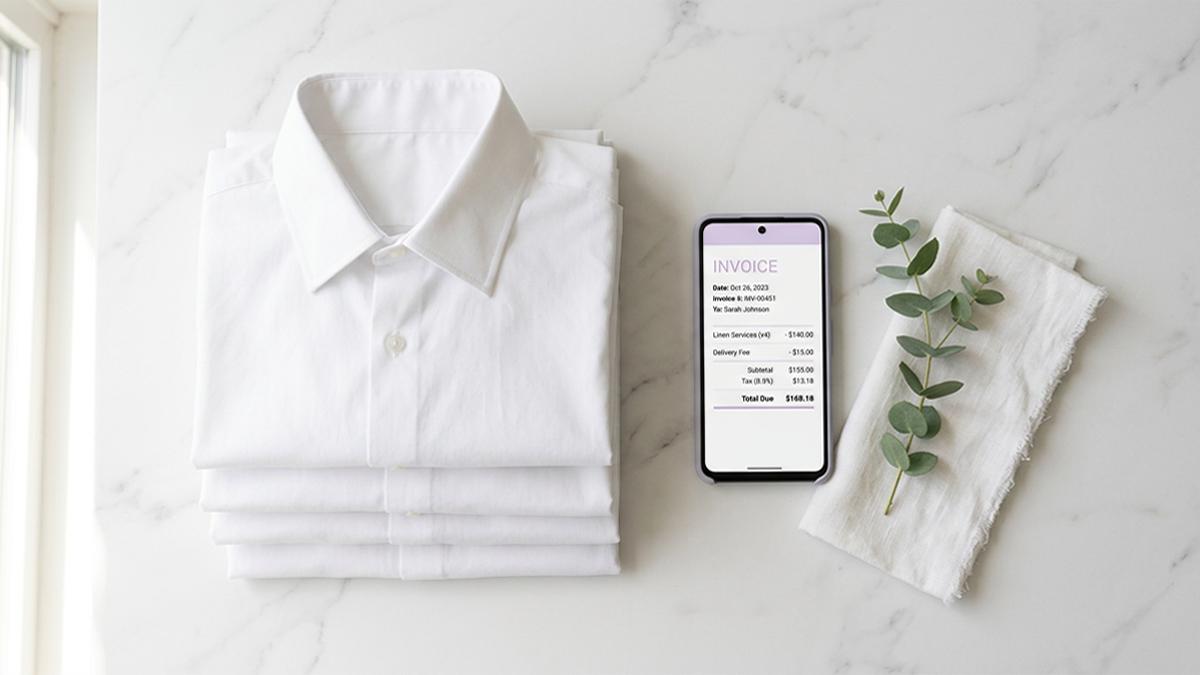
Regardless of whether you send a paper invoice, a PDF, or a digital link, every invoice should contain:
- Your business name and contact details: Your trading name, phone number, email address, and town or city. If you have a website or booking page, include it.
- The customer's name and address. For domestic clients, the first name and postcode are sufficient. For business clients — B&Bs, offices, care homes — include the full business name and address.
- A unique invoice number. Start at 001 and count up. Invoice numbers make it easy to refer to a specific job in any conversation or dispute. They are also useful for your accounts.
- Invoice date and payment due date. The invoice date is when you issued it. Payment due date is when you expect to be paid — typically the same day for domestic clients, or 7–14 days for business accounts.
- A clear breakdown of what was done. List each item or service with the quantity and unit price. For ironing, that means individual line items (e.g. "Shirts × 6 @ £2.00 = £12.00"). For wash-and-fold, it means the weight and rate (e.g. "8 kg @ £1.60/kg = £12.80"). Vague totals — "Laundry services — £45" — invite disputes.
- Any applicable discounts If a customer has a loyalty discount or you agreed on a reduced rate, show it as a separate line. Transparency builds trust.
- The total amount due. Clear, bold, unmissable. Include whether VAT applies (most sole traders operating below the £90,000 threshold will not charge VAT).
- How you want to be paid: Bank transfer details (sort code and account number), a card payment link, or a note that you accept cash on collection. The easier you make it to pay, the faster you get paid.
Pricing your invoice correctly
Before you can invoice accurately, you need a consistent rate card. For ironing services, per-item pricing is standard — shirts, trousers, dresses, bed linen all have separate rates. For wash-and-fold, per-kg pricing is the norm.
If you are still working out your rates, the Ironing Service Pricing Guide UK: How to Set Your Rates Per Item covers typical UK market rates for 2024–25 and the factors that should influence where you sit in that range. Get your rate card right before you scale — repricing existing customers later is harder than starting at the right level.
When to send the invoice
The timing of your invoice affects how quickly you get paid. Common approaches:
On collection or delivery, send the invoice at the same time you return the clothes. The job is fresh in everyone's mind, the customer has received what they paid for, and there is no delay between service and payment request. This is the simplest model and works well for domestic clients.
Same day, by email. If you do not hand over a physical receipt, email the invoice immediately after collection or delivery — ideally within the hour. Invoices sent the same day are paid faster than invoices sent days or weeks later. Once a customer has moved on mentally, chasing becomes harder.
At the end of the month (for business accounts), commercial clients — hotels, care homes, offices — typically prefer a single consolidated invoice at the end of the month covering all jobs in that period. This is called consolidated or monthly invoicing. Set this up explicitly with any business client at the start of the relationship.
How to send invoices professionally
PDF by email: A branded PDF invoice with your logo is the standard for professional service businesses. It looks more credible than a plain text email, it is easy for the customer to save or print, and it is easy for you to keep a copy.
Digital payment links: Combining a PDF invoice with a pay-by-card link is increasingly the norm. The customer opens the email, reads the invoice, clicks the link, and pays by card in seconds. This removes the friction of bank transfers and eliminates cash handling. Stripe, for example, generates secure one-click payment links that settle to your bank account quickly.
Paper receipts. For customers who prefer in-person payment or who are not digitally confident, a pre-printed receipt book still works. Use it alongside a digital copy for your own records.
WhatsApp and messaging apps: Sending a total over WhatsApp might seem convenient, but it creates no paper trail and offers no payment mechanism beyond asking the customer to do a bank transfer from memory. Keep informal messages for logistics (collection time, booking confirmation) and send formal invoices by email.
Getting paid faster
The single biggest change you can make to speed up payment is to offer card payment. Bank transfers require the customer to log into their banking app, enter their details manually, and remember to do it. A card link takes fifteen seconds.
Other practical steps:
- Set a clear due date — "payment on delivery" or "due within 3 days" — and put it on the invoice.
- Send a reminder — a polite message one day after a missed payment due date recovers most overdue invoices without any awkwardness.
- Use automatic SMS updates — if your customer gets a message saying their laundry is ready and the invoice link is in the same message, they often pay before you have even finished the delivery round.
- Offer a small incentive for prompt payment — some operators offer 5% off for same-day payment on larger orders. This is more effective with business clients than domestic ones.
Handling late or unpaid invoices
Most late payments from domestic laundry customers are not deliberate — they forget, they lose the email, or they get busy. Your first response should always be a friendly reminder, not a formal demand.
A practical escalation process:
- Day 1 after due date: Polite reminder email or text — "Just a reminder that invoice #007 for £24.00 is due. Payment link here."
- Day 7: Follow-up message — "I have not received payment for invoice #007 yet. Please let me know if there is an issue."
- Day 14: Direct conversation — if you are still collecting from this customer, raise it in person. Most disputes are resolved at this stage.
- Day 21+: Formal written notice if the amount is significant. For sole traders with small balances, the practical limit is whether the relationship is worth continuing.
For business accounts, it is worth including payment terms in your initial agreement — for example, "payment within 14 days of invoice" — and referencing the Late Payment of Commercial Debts (Interest) Act 1998 for any formal correspondence, which entitles you to statutory interest on overdue B2B invoices.
Keeping records — what HMRC expects
If you are registered as self-employed — which you should be if you earn more than £1,000 per year from your laundry business (see How to Run a Laundry Business From Home in the UK for the full setup guide) — HMRC requires you to keep records of all your income and expenses for at least five years after the relevant Self Assessment filing deadline.
In practice, this means:
- Keep a copy of every invoice you send, with the invoice number, date, amount, and customer name.
- Keep records of whether each invoice was paid, and when.
- Keep receipts for your business expenses — detergent, equipment, fuel for collections, and packaging.
A spreadsheet works for a small number of customers. As the business grows, dedicated software makes this significantly less painful.
How DashGrow handles laundry invoicing
If you are still creating invoices manually — whether in Word, Excel, or a receipt book — the process above is still entirely manageable. At a certain scale, though, every invoice you create by hand is time you are not spending on the work itself.
DashGrow is built specifically for UK laundry and ironing operators. From a single dashboard, you can:
- Store your per-item and per-kg price list in a pricing catalogue
- Create a booking and generate a branded PDF invoice in seconds
- Email the invoice directly to the customer from the dashboard
- Attach a Stripe pay-by-card link so the customer can pay immediately
- Send an automatic SMS when the order is ready, and the invoice is waiting
- Track which invoices are paid, unpaid, and overdue
The booking system generates your invoice directly from the job — see the full laundry booking system overview.
The free plan covers your first 15 bookings per month with no card required. The Pro plan (£17/month) unlocks unlimited bookings, branded invoices with your logo, Stripe payment links, SMS notifications, and monthly reports. There is a 14-day free trial of Pro when you sign up.
Invoicing is one component of a wider laundry management system — DashGrow connects pricing, invoices, and payments in the same dashboard.
Summary
Professional invoicing for a laundry business comes down to a few consistent habits: include the right information every time, send invoices promptly, make it easy for customers to pay, and keep records. These habits take five minutes to set up and save hours of chasing and confusion as the business grows.
If you have not already set your rate card, start with the Ironing Service Pricing Guide UK before you finalise your invoice template — your prices and your invoice format should be decided together. Once you have the fundamentals in place, you can focus on how to get more laundry customers in the UK and scaling your operation.