Ironing Service Rates UK: Regional Pricing & Item-Type Breakdown 2026
Compare ironing service rates UK by region and item type. London, Manchester, Bristol pricing guides for laundry operators.
If you're running a laundry or ironing service across the UK, you've probably noticed that what you charge in London doesn't work the same way in Manchester or Bristol. Ironing service rates UK vary significantly by region, customer expectations, and the complexity of what you're pressing—and getting this right is crucial to staying competitive whilst protecting your margins. A crisp cotton shirt might command £2.50 in central London but £1.80 in a market town, and a delicate silk blouse requires different handling (and pricing) than a standard work shirt.
The challenge for operators is that there's no single "correct" rate. Your pricing needs to reflect local demand, cost of living, labour expenses, and the specific garment type. Too high, and customers shop around; too low, and you're burning time on work that doesn't justify the effort. This guide breaks down ironing service rates by region—from premium London pricing to competitive regional rates—and then dives into item-type specifics so you can build a pricing structure that works for your business and your market.
Why Ironing Service Rates Vary Across the UK
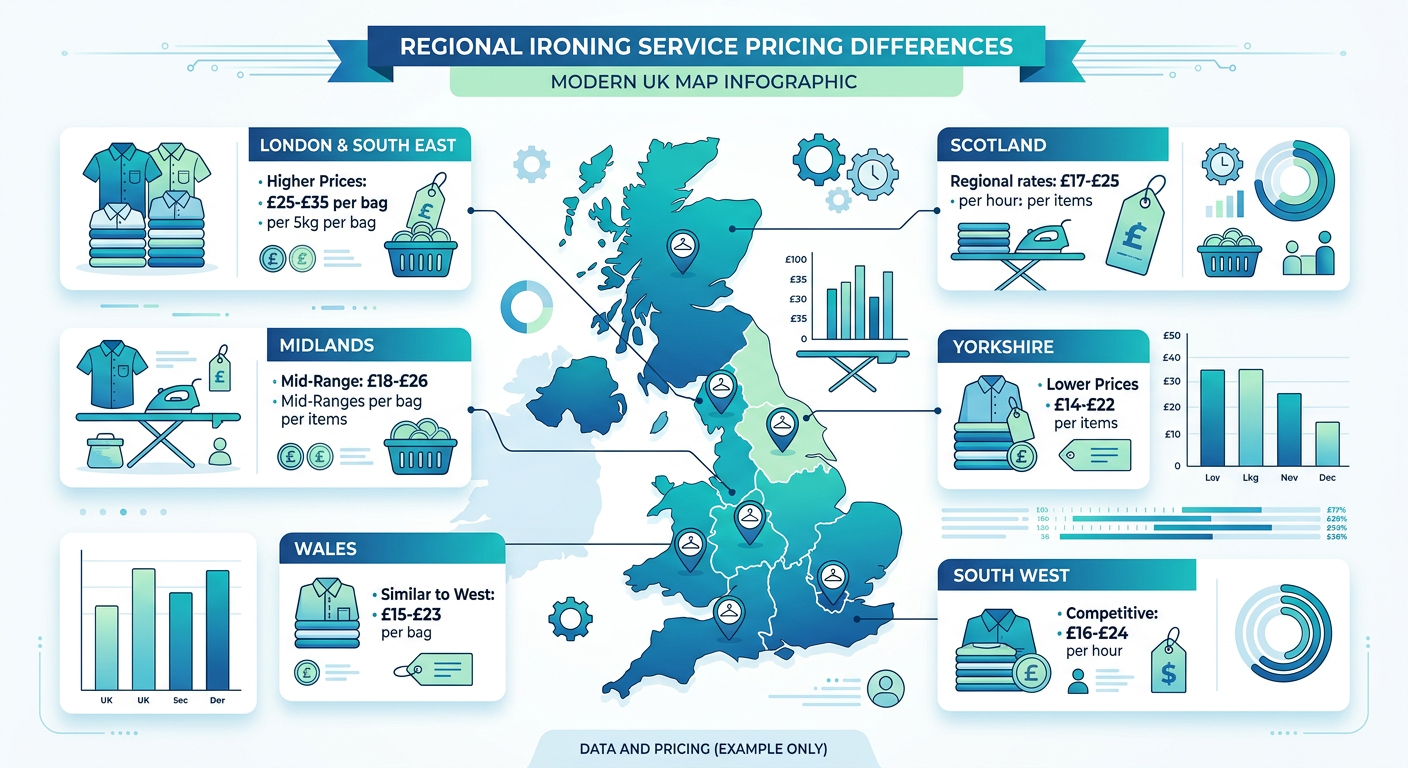
Ironing service rates across the UK aren't arbitrary—they're shaped by a mix of economic, operational, and market factors that differ significantly from one region to another. Cost of living is the most obvious driver: London and the South East have higher rents, higher staff wages, and higher customer spending power, which means operators can charge more per item and still remain competitive. A small ironing business in central London might pay £1,200–£1,500 monthly for a modest workspace, whilst the same space in Leicester or Sunderland could cost £400–£600. That overhead difference directly affects what you need to charge to maintain healthy margins.
Local demand and customer expectations also play a major role. In affluent postcodes, customers expect premium service—faster turnarounds, specialist handling for delicates, and convenient pick-up and drop-off. They're willing to pay for it. In more price-sensitive areas, volume and efficiency matter more; customers shop on price first, so your rates need to be competitive but your throughput needs to be higher to compensate. A London operator might iron 40 items per day at £2–£3 each; a regional operator might need to hit 60–80 items per day at £1.50–£2 each to hit the same weekly revenue.
Labour availability and skill level also shift the dial. In major cities, you may need to pay more to attract reliable staff or retain experienced pressers who can handle delicate fabrics without damage. In smaller towns, labour costs are often lower, but you may have fewer skilled workers to choose from. If you're a sole operator, your own time is the constraint—and how you value that hour varies by market. Ironing Service Pricing Guide UK: How to Set Your Rates Per Item covers cost-per-item frameworks in detail, but the regional context is essential: the same cost model applied uniformly across the UK will either price you out of regional markets or leave money on the table in London.
Seasonal and competitive pressure round out the picture. Summer holidays, Christmas, and wedding season drive demand spikes in tourist areas and affluent regions; rural and post-industrial areas may see steadier but lower overall demand. Competitor density matters too—if there are five ironing services within a mile radius, rates compress; if you're the only operator in a market town, you have more pricing flexibility. Understanding these regional dynamics helps you set rates that reflect your actual costs, local competition, and customer willingness to pay—rather than guessing or copying a national average that may not apply to your patch.
London & South East Ironing Rates vs. Regional Pricing
London and the South East command the highest ironing service rates in the UK, typically 30–50% above regional averages. A premium London operator charges £2.50–£3.50 per shirt, £3–£4 per pair of trousers, and £4–£5.50 for dresses. In contrast, operators in the Midlands, North West, and Yorkshire charge £1.50–£2.20 per shirt, £2–£2.80 per pair of trousers, and £2.50–£3.50 for dresses. This gap reflects higher London rents, labour costs, and customer spending power. A South East operator working from a home base in Surrey or Kent typically sits in the middle: £2–£2.80 per shirt, £2.50–£3.50 per pair of trousers, and £3–£4.50 for dresses.
Demand density amplifies these differences. In central London postcodes (SW1, W1, EC1), customers expect next-day or same-day turnarounds and are willing to pay premium rates for convenience and reliability. A Mayfair-based ironing service can sustain £3.50+ per shirt because the customer base has high disposable income and values time over cost. Move to outer London zones (zones 3–4) or the Home Counties, and rates drop to £2.20–£2.80 per shirt as competition increases and customer price sensitivity rises. In smaller regional cities like Leeds, Manchester, or Bristol, operators typically charge £1.80–£2.40 per shirt and rely on higher volume to maintain profitability.
Delicate items show the sharpest regional variation. London operators charge £5–£7 for silk blouses, £6–£8 for linen dresses, and £4–£6 for cashmere jumpers. Regional operators charge £3–£4.50 for silk blouses, £4–£5.50 for linen dresses, and £2.50–£4 for cashmere. This reflects both the concentration of high-value wardrobes in London and the specialist skill required—which commands higher wages in the capital. If you operate across multiple regions or are planning to expand, benchmarking your rates against local competitors and adjusting for item complexity and fabric type is essential. How to Get More Laundry Customers in the UK: 10 Proven Strategies includes guidance on positioning your pricing competitively within your local market.
The practical takeaway: don't apply a flat national rate. Survey your immediate competitors, check what customers in your postcode are paying, and factor in your own labour costs and overhead. A home-based operator in a market town can profitably charge £1.60–£2 per shirt; a London operator with premises and staff needs £2.80+ to cover costs and generate margin. Your booking system should allow you to set region-specific or postcode-specific rates so you're not leaving money on the table in affluent areas or pricing yourself out of competitive ones.
Item-Type Rate Breakdown: Shirts, Trousers, Dresses & Delicates
Not all ironing is created equal. The complexity of the garment, fabric type, and finishing requirements mean your rates should vary significantly by item. Shirts are your volume driver and typically command the lowest per-item rate: London operators charge £2.50–£3.50 per shirt, while regional operators in Manchester, Leeds, or Birmingham charge £1.80–£2.40. The difference reflects both local wage costs and customer expectations. Trousers sit slightly higher at £2–£3 in London (due to pressing complexity and crease retention) and £1.50–£2.20 regionally. Dresses vary wildly depending on fabric and style—a simple cotton dress might be £2.50–£3.50 in London, but a structured or pleated dress can reach £4–£5 because it demands more skill and time.
Delicate items are where you protect your margin and demonstrate specialist value. Silk blouses command £5–£7 in London and £3–£4.50 regionally; linen dresses reach £6–£8 in the capital and £4–£5.50 outside it. Cashmere jumpers, which require low heat and careful handling, sit at £4–£6 (London) and £2.50–£4 (regional). These premiums reflect both the risk of damage and the specialist skill required—customers understand they're paying for expertise, not just labour. Delicate fabrics also tend to cluster among higher-income households, which is why London's concentration of affluent customers supports these elevated rates.
When setting your own item-type rates, start by mapping your local competitor landscape. Check what three to five established operators near you charge for a standard shirt, a pair of trousers, and a silk blouse. Then adjust upward if you offer faster turnaround, premium finishing (hand-pressing, starch options), or serve a more affluent postcode. Downward adjustments make sense if you're building volume in a price-sensitive area or competing against larger chains. Your booking system should let you define rates by item type and region so you can offer £2.80 per shirt in Kensington but £1.90 in Coventry without manual recalculation. Ironing Service Pricing Guide UK: How to Set Your Rates Per Item includes a detailed rate card template you can customise by fabric and garment type.
One practical tip: bundle delicates into a separate service tier or clearly label them at checkout. Customers expect to pay more for silk and cashmere, but they need to see the distinction upfront. If you lump everything under 'ironing', you'll either underprice delicates or confuse customers with a single high rate that deters them from ordering basic shirts.
Seasonal & Demand-Led Rate Adjustments
Ironing demand swings sharply across the calendar, and smart operators adjust rates to match. September and January see peaks as customers return to office work after summer and New Year breaks—many operators raise rates by 10–15% during these months, or introduce a small peak-season surcharge (e.g. +£0.30 per shirt). Winter also brings formal events: Christmas parties, New Year galas, and winter weddings drive demand for dresses, waistcoats, and tailored trousers. A London operator might charge £5.50 for a formal dress in November–December versus £4 in July, reflecting both scarcity of capacity and willingness to pay among event-bound customers.
Regional variation amplifies seasonal swings. In affluent South East commuter towns, September demand is intense as professionals return to London offices; rural areas and post-industrial regions often see steadier, flatter demand year-round. If you operate across multiple regions, your booking system should flag when one area hits capacity so you can nudge rates upward without losing customers to competitors. A 5–10% rise often reduces demand just enough to keep turnaround times manageable without alienating your base.
Bank holidays and school holidays create inverse peaks. Easter and summer holidays reduce office-worker demand but increase family holiday-prep ironing (lightweight dresses, holiday shirts). Some operators discount slightly during these troughs to maintain volume; others hold firm and use the quieter weeks for maintenance, training, or admin catch-up. The key is consistency: if you raise rates in September, communicate it clearly via SMS or email so customers aren't surprised at checkout.
Weather also plays a role, especially for delicates. Humid summers increase fabric care complexity and risk of mildew or water marks, so some operators charge 10–15% more for silk and linen June–August. Conversely, winter's dry air makes delicate handling easier, so rates can soften slightly. Track your actual turnaround times and damage claims by season—if you're rushing through summer orders and seeing more complaints, a rate rise is justified and protects your reputation. How to Get More Laundry Customers in the UK: 10 Proven Strategies covers how to communicate rate changes without losing loyalty.
How to Use Regional Data to Set Your Own Rates
Start by benchmarking against your region. If you operate in London or the South East, the data above gives you a floor: shirts at £1.20–£1.50, trousers at £2–£2.50, dresses at £3.50–£5.50. But your actual rate depends on three things: your local competition, your turnaround time, and your target customer segment. A premium operator in Kensington offering next-day service can charge 20–30% above the regional average; a budget service in a commuter town might undercut by 10–15% to build volume. The trick is not to chase the lowest price. Instead, pick a positioning (premium, mid-market, or value) and set rates consistently within it. Use your booking system to track which item types and time slots fill fastest—if formal dresses book solid three weeks ahead but casual shirts have gaps, you're underpriced on dresses or overpriced on shirts.
Next, segment your pricing by item complexity and regional demand. A worked example: you operate in Manchester and Birmingham. In Manchester, a silk blouse might be £2.20 (regional average); in Birmingham, £2.00 (lower local wages, softer market). But if you're the only operator offering same-day silk service in either city, you can charge £2.80–£3.00 without losing customers. Conversely, if three competitors offer standard shirts at £1.00 in your area, matching that rate protects volume—but add a £0.30 premium for express (24-hour) turnaround. This way, you're not cutting rates across the board; you're using regional data as a baseline and adjusting by service level and scarcity. Ironing Service Pricing Guide UK: How to Set Your Rates Per Item includes a downloadable rate card template you can customise by region and item type.
Track your own costs and margins ruthlessly. If your labour cost is £12/hour and you can iron 15 shirts per hour, your labour cost per shirt is £0.80. Add 15–20% for overheads (utilities, equipment depreciation, insurance) and you need to charge at least £0.95–£1.00 to break even. Regional data tells you what the market will bear; your cost data tells you what you need to survive. If the two don't align—say, your local market tops out at £0.90 per shirt but your costs are £1.05—you have three options: raise prices (risking volume), improve efficiency (batch similar items, invest in better equipment), or exit that segment and focus on higher-margin work like delicates or formal wear. Don't compete on price alone; compete on speed, reliability, and specialisation.
Finally, use seasonal and demand data to adjust rates dynamically without alienating customers. If you're in the South East and September demand is 40% above August, a 5–8% rate rise is justified and expected. Communicate it in advance: "From 1 September, express turnaround (24 hours) moves to £1.60 per shirt; standard (3–5 days) stays at £1.20." Customers who need speed will pay; those who can wait will book standard. This keeps your calendar full without burning out your team. If you're using a booking system with SMS and email integration, you can A/B test rate changes on new customers while grandfathering existing ones—a tactic that builds loyalty and reduces churn. Over time, your regional data becomes your own: you'll know exactly which rates, seasons, and item types drive profit, and you can set prices with confidence rather than guesswork.
Common Pricing Mistakes & How to Avoid Them
The most common mistake is setting rates based on what competitors charge without understanding your own cost structure. You see a rival in Manchester charging £0.85 per shirt and match it—but if your labour cost is £12/hour and you can only iron 12 shirts per hour (not 15), your labour cost per shirt is already £1.00. You're losing money on every order. Instead, calculate your true cost per item: divide your hourly rate by the number of items you can process per hour, add 15–20% for overheads (utilities, equipment wear, insurance), then check what the regional market will bear. If your costs exceed local rates, you have three levers: raise prices (and accept lower volume), improve efficiency (batch similar fabrics, upgrade your equipment), or specialise in higher-margin work like delicates or formal wear where customers expect to pay more.
Another pitfall is underpricing delicates and complex items to fill capacity. A silk blouse takes 8–10 minutes to iron safely; a cotton shirt takes 4–5. If you charge the same rate for both, you're earning half the hourly rate on the blouse. Regional data shows London operators charge 40–60% more for delicates than for standard cotton shirts—not because they're greedy, but because the work is slower and the liability is higher. Set item-type rates that reflect actual time and risk, then use regional benchmarks to calibrate the premium. A delicate in London might be £2.50; in the Midlands, £1.80. Both are profitable if your costs are covered.
Third, many operators fail to adjust rates seasonally or by demand, then wonder why September is chaotic and January is quiet. If your booking system shows 40% more demand in September (back-to-school, new term, events), a 5–8% rate increase is justified and expected by customers. Communicate it early: "From 1 September, express turnaround (24 hours) is £1.60 per shirt; standard (3–5 days) stays at £1.20." Customers who need speed will pay; those who can wait will book standard. This keeps your calendar balanced without burning out your team. How to Invoice Your Laundry Customers Professionally covers how to communicate rate changes clearly and maintain customer trust when you adjust pricing.
Finally, don't set rates in isolation. Track your costs, benchmark against regional data, and monitor what actually sells. If you're in the South East and your delicate rate is £2.20 but customers consistently book at £2.50, you're leaving money on the table. Conversely, if your express rate is £1.80 and bookings drop off, you may be above the local ceiling. Use a booking system with clear pricing visibility so you can see which rates drive volume and which drive margin—then adjust quarterly based on your own data, not guesswork.
Tools & Templates to Manage Multi-Region Pricing
Managing different rates across regions and item types manually—via spreadsheets or mental maths—is a recipe for inconsistency and lost revenue. A dedicated booking system lets you set regional rate cards once, then apply them automatically to every booking. For example, you can configure that a standard cotton shirt costs £1.20 in the Midlands, £1.60 in London, and £1.40 in the South East. When a customer books from a postcode, the system pulls the correct regional rate and shows it at checkout. No double-checking, no mistakes, no customer disputes about why their invoice differs from a friend's in another town.
Within each region, you should also layer item-type pricing so that delicates, formal wear, and standard items are charged appropriately. A practical template approach: create a simple table with columns for item type, base rate (Midlands/regional), London multiplier (typically 1.3–1.5×), and South East multiplier (typically 1.2–1.4×). For instance, a silk blouse might be base £2.00 (Midlands), £2.60 (London), £2.40 (South East). A cotton shirt might be base £1.00, £1.60, £1.40. This keeps your pricing logic transparent and scalable. DashGrow's laundry booking system lets you store and manage these rate cards by postcode or region, so every quote and invoice reflects your actual regional strategy without manual intervention.
Seasonal and demand-led adjustments are easier to implement and track when you have a system that logs booking volume and revenue by item type and region. For example, you might notice that in September, London express ironing bookings spike 45% but your standard rate stays flat. You can then create a seasonal rate card (valid 1 September–30 October) that increases express rates by 6% while keeping standard rates steady. The system applies the seasonal card automatically during that window, then reverts to your baseline rates. This removes the guesswork and ensures you're not manually overriding prices mid-month.
Finally, use your booking data to audit pricing quarterly. Pull a report showing revenue per item type, per region, and per turnaround option. If delicates in the South East are generating lower margin than expected, or if standard rates in the Midlands are driving high volume but low profit, you have concrete evidence to adjust. Many operators find that a simple quarterly review—comparing actual rates charged, volume booked, and margin achieved—reveals opportunities to raise rates by 3–5% without losing customers, or to rebalance the mix (e.g., promote higher-margin express options). This data-driven approach beats guesswork and keeps your pricing competitive and profitable across all regions.
Conclusion
Ironing service rates across the UK are far from one-size-fits-all. London and the South East command premiums of 20–50% over regional bases, whilst item complexity—from basic cotton shirts to delicate silks—justifies meaningful rate variation. The key is building a transparent, scalable rate card that reflects both geography and fabric type, then automating it within your booking system so every quote is consistent and profitable. Whether you're operating in Manchester or Mayfair, the principle remains: know your costs, understand your market, and price accordingly.
The operators winning on pricing aren't those guessing month-to-month; they're the ones auditing their data quarterly, spotting seasonal demand spikes, and adjusting rates with confidence. Use the regional multipliers and item-type benchmarks in this guide as a starting point, then refine based on your actual booking patterns and margins. A laundry management platform that tracks rates by postcode and item type—and applies seasonal adjustments automatically—removes friction and ensures you're never leaving money on the table. Start with a simple rate card this quarter, review your data in three months, and adjust. Small, data-backed changes compound into significantly stronger margins across all regions.